
The recurring payment gap in web3
Bringing the subscription model on-chain has historically been a exercise in compromise. Modern economies run on recurring payments, from SaaS tools to streaming services, but replicating this infrastructure on a blockchain is not a simple copy-paste job. The friction lies in the fundamental difference between push and pull payments.
In a traditional web2 model, the merchant initiates the charge. On-chain, transactions are inherently push-based: the user must sign and send each payment. To simulate a subscription, developers have relied on workarounds that introduce significant complexity and risk. Early solutions often required users to wrap tokens, deposit funds into escrow contracts, or rely on third-party relayer networks to execute payments on their behalf.
These legacy systems create a poor user experience and high operational overhead. Escrow mechanisms lock up capital, wrapping adds unnecessary gas costs, and relayer networks introduce centralization points that contradict the ethos of decentralized finance. For on-chain subscriptions to scale in 2026, the infrastructure must shift from these patchwork solutions to native, protocol-level support for recurring pull payments.
The shift toward native on-chain subscriptions is not just a convenience upgrade; it is a necessary infrastructure evolution. By removing the need for escrow and wrapping, native protocols allow merchants to offer a "subscribe and forget" experience that matches the simplicity of web2, while retaining the transparency and security of the blockchain.
How Solana Handles Native Billing
Solana’s new billing program shifts recurring payments from external databases to the blockchain itself. Developers can now build subscription tiers, payroll systems, and AI agent budgets directly on-chain. This native approach removes the need for third-party escrow services, reducing friction and cost for both creators and consumers.
The infrastructure supports delegated spending, allowing users to authorize recurring payments without manual intervention for each transaction. This is particularly useful for AI agents that need to autonomously pay for API calls or data services. By handling these transactions natively, Solana enables a new class of autonomous economic activity that was previously too complex or expensive to manage.
Integration is already underway. Helius is using the program to manage API billing through subscription tiers, while Confirmo plans to leverage it for stablecoin invoice collection. This shift toward native on-chain subscriptions marks a significant step in the maturation of blockchain-based finance, moving beyond simple transfers to structured, recurring economic relationships.
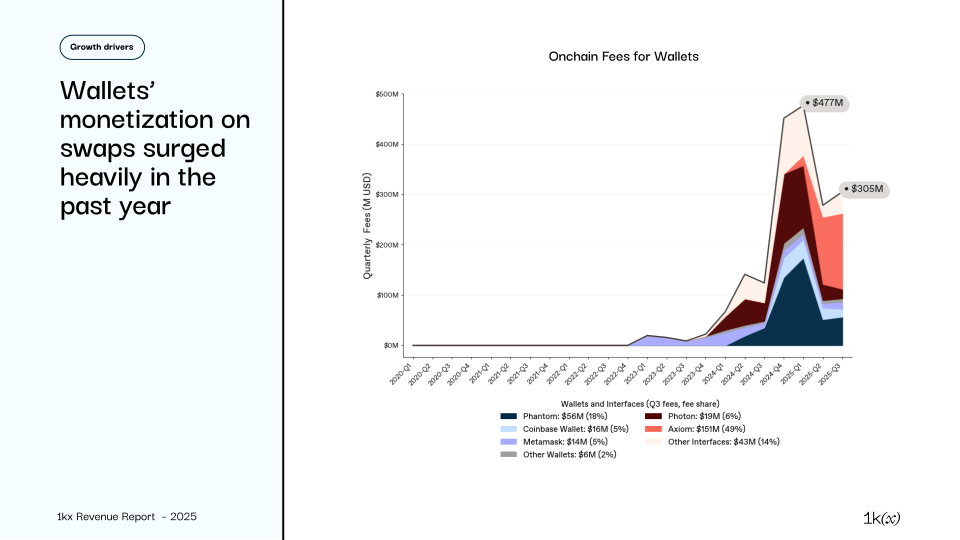
The move toward native billing also impacts network dynamics. As more services adopt on-chain subscriptions, the frequency of small, recurring transactions increases. This can drive higher network utilization and potentially influence token velocity. Understanding these micro-transactions is key to grasping the broader impact of on-chain subscriptions on the Solana ecosystem.
Comparing subscription architectures
The shift from legacy Web2 payment processors to native on-chain solutions represents more than a technical upgrade; it is a fundamental change in how recurring revenue is managed. Legacy platforms like Stripe and Paddle act as centralized intermediaries, holding funds and enforcing rules that can change overnight. In contrast, on-chain subscription architectures move money directly between digital wallets, verified and settled on the blockchain network without third-party intermediaries.
This structural difference impacts three critical areas for merchants: settlement speed, fee structures, and chargeback risk. While Web2 systems offer familiarity, they often come with high friction in the form of delayed payouts and mandatory chargeback protections that favor consumers. On-chain models, particularly those using modern recurring payment protocols, aim to eliminate these inefficiencies by automating the subscription lifecycle directly on the ledger.
The following comparison highlights the operational realities of both models. It focuses on the metrics that matter most for businesses scaling recurring revenue in 2026.
| Metric | Web2 (Stripe/Paddle) | On-Chain Solutions |
|---|---|---|
| Settlement Time | T+2 to T+7 business days | Minutes to seconds |
| Processing Fees | 2.9% + $0.30 per transaction | Network gas + protocol fee (<1%) |
| Chargeback Risk | High; merchant bears full risk | Low; transactions are immutable |
| User Experience | Familiar credit card flow | Wallet-based, requires crypto literacy |
| Control & Intermediaries | Centralized; account freezes possible | Decentralized; self-custody |
Settlement speed is perhaps the most immediate benefit. Web2 processors typically hold funds for several days to mitigate fraud risk, creating cash flow gaps for small businesses. On-chain subscriptions settle in minutes or seconds, depending on the network congestion. This immediacy allows merchants to reinvest revenue faster, a significant advantage in volatile market conditions.
Fees also differ sharply. Traditional processors charge a flat percentage plus a fixed fee per transaction, which can eat into margins for low-ticket subscriptions. On-chain solutions primarily incur network gas fees and a small protocol fee, often resulting in lower overall costs, especially for higher-volume merchants. However, this advantage depends on the underlying blockchain’s fee structure; Layer 2 solutions like Arbitrum or Base often offer near-zero gas fees, making them ideal for micro-subscriptions.
Chargeback risk is another major differentiator. Web2 systems rely on reversible transactions, meaning merchants can lose both the product and the revenue if a customer disputes a charge. On-chain transactions are immutable; once confirmed, they cannot be reversed. This eliminates chargeback fraud but requires merchants to provide exceptional customer service and clear refund mechanisms within the protocol itself.
User experience remains the primary hurdle for on-chain adoption. Web2 payments feel seamless to users accustomed to entering credit card details. On-chain subscriptions require users to manage digital wallets and hold cryptocurrency, which can be a barrier for mainstream audiences. However, as abstraction layers improve—allowing users to pay with fiat while the backend handles the crypto conversion—this gap is narrowing rapidly.
Implementing token-gated loyalty programs
On-chain subscriptions shift loyalty from a marketing promise to a verifiable state. By tying access directly to wallet activity, creators can replace static membership tiers with dynamic, real-time perks. This approach transforms retention from a guess into a measurable metric, where the blockchain itself serves as the immutable ledger of who is still paying and who is still engaged.
The core mechanism relies on token-gating. When a subscriber’s wallet holds a specific token or maintains an active subscription contract, access is automatically granted or revoked. This eliminates the friction of manual checks and prevents the "ghost subscriber" problem common in traditional platforms. Loyalty becomes a function of continuous participation rather than a one-time purchase.
This model also protects creator-partner relationships through on-chain attribution. As noted by Droplinked, leveraging on-chain data guarantees accurate commissions and eliminates fraud associated with bad actors. Every interaction is transparent, ensuring that loyalty rewards are distributed fairly based on actual wallet activity rather than opaque algorithms.
The result is a loyalty loop that is self-correcting and transparent. Subscribers see exactly what they are getting for their recurring payments, and creators see exactly who is staying. This clarity reduces churn by aligning incentives: the platform only succeeds when the subscriber’s wallet remains active and engaged.
Common Pitfalls in On-Chain Billing
On-chain subscriptions promise frictionless recurring revenue, but the reality of blockchain infrastructure introduces distinct failure points that off-chain systems rarely face. Unlike a credit card processor that handles retries in the background, on-chain transactions are immediate, irreversible, and dependent on network conditions. If your implementation doesn't account for these variables, user churn will spike before you even notice the revenue drop.
Gas fluctuation is the most immediate technical hurdle. Subscription renewal requires a transaction to be mined. If gas prices spike during renewal windows, your smart contract or relayer may fail to execute the payment, causing the subscription to lapse. This isn't just a backend error; it's a broken promise to the user. You must design fallback mechanisms, such as gasless meta-transactions or batched renewals, to ensure payments go through even during network congestion.
Wallet connectivity and user experience create a second layer of risk. Users may switch networks, disconnect wallets, or run out of native token balance for gas, all of which halt recurring payments. Unlike off-chain billing, you cannot easily "retry" a failed on-chain transaction without explicit user interaction. This friction demands clear, proactive communication. Users need to know exactly when their next charge is scheduled and what assets are required to make it happen.
Finally, the lack of standardized notification protocols means you are responsible for keeping users informed. If a renewal fails due to insufficient funds or a network error, the user shouldn't discover this weeks later when their access is revoked. Implementing clear error states and manual retry flows is essential. Without these safeguards, the complexity of blockchain becomes a barrier rather than a feature.
Frequently asked questions about on-chain subscriptions
What are on-chain payments?
On-chain payments move money directly between digital wallets, with every transaction verified and settled on the blockchain network itself. There are no third-party intermediaries like banks or payment processors; the blockchain acts as both the network and the ledger. This direct settlement is the foundation of native recurring payments, allowing merchants to offer "subscribe and forget" models without relying on escrow or relayer networks.
Which crypto uses on-chain transactions?
Most major assets support on-chain transactions once confirmed, including Bitcoin (BTC), Ethereum (ETH), and Tron (TRX). These networks permanently record the transaction history, ensuring transparency and immutability. However, cryptocurrencies based on directed acyclic graphs (DAGs), such as Nano or IOTA, operate differently and cannot be used for traditional on-chain transactions in the same way.
Do on-chain subscriptions require token wrapping?
No. Early web3 payment solutions often required complex token wrapping or bridging to handle recurring billing. Modern on-chain subscription protocols eliminate this friction by enabling direct native token payments. This means you can subscribe to services using standard ETH or USDC without converting assets into wrapped versions or relying on third-party relayers.
How are recurring payments automated on-chain?
Automation relies on smart contracts that execute payments at predetermined intervals. Once a user approves the contract, it automatically deducts the subscription fee from their wallet balance on the due date. This process removes the need for manual renewals or constant approval, creating a seamless experience similar to traditional fiat subscriptions but with full transparency on the blockchain.
No comments yet. Be the first to share your thoughts!