The shift to direct creator payments
The creator economy is undergoing a structural reset. In 2026, the friction of traditional platform payouts—high fees, opaque algorithms, and delayed settlements—is pushing creators toward onchain subscriptions. This shift isn't just about technology; it's about reclaiming the revenue stream. Creators are moving from being tenants on centralized platforms to owners of their own financial rails.
Onchain subscriptions allow creators to receive recurring payments directly from supporters without intermediaries taking a significant cut. This model eliminates the need for complex escrow systems or token wrapping, as highlighted by recent protocol developments in the space. The result is a "subscribe and forget" experience where funds flow instantly and transparently.
The core value proposition of onchain subscriptions is lower fees and direct ownership for creators compared to Web2 platforms.
This transition mirrors the early days of e-commerce, where merchants bypassed gatekeepers to build direct relationships with customers. For creators, this means predictable income and true ownership of their audience data. As the infrastructure matures, the gap between Web2 convenience and Web3 ownership is closing, making onchain payments a viable primary income source rather than a niche experiment.
Key platforms enabling onchain subscriptions
The shift toward onchain subscriptions in 2026 is no longer theoretical; it is being driven by platforms that prioritize seamless user experience over technical novelty. Early adopters faced friction—complex wallet setups, gas fees, and confusing token interactions. Today, the leading protocols abstract these complexities, allowing creators to monetize directly while subscribers interact with familiar, web2-like interfaces. This reduction in friction is the primary catalyst for mass adoption.
Onchain Foundation and Protocol Standardization
The Onchain Foundation has emerged as a critical non-profit organization advancing the implementation of blockchain-based applications. By focusing on research and development, they are helping to standardize how subscriptions are structured on-chain. Their work reduces fragmentation, ensuring that a subscription built on one compatible chain can be managed across others. This interoperability is essential for creators who do not want to be locked into a single ecosystem. The foundation’s efforts provide the foundational layer that allows other platforms to build user-friendly tools on top of secure, standardized protocols.
SpherePay and "True" On-Chain Subscriptions
SpherePay represents a significant leap in user experience by enabling "true" on-chain subscriptions. Unlike previous models that required escrow, token wrapping, or relayer networks, SpherePay allows merchants to offer a "subscribe and forget" model. This approach eliminates the need for subscribers to manage complex crypto mechanics for every renewal. The platform handles the backend complexity, allowing creators to receive recurring payments in stablecoins or native tokens without the subscriber ever interacting with a smart contract directly. This simplicity is what bridges the gap between crypto-native users and the broader creator economy.
Comparison of Leading Platforms
The landscape of onchain subscription platforms varies in transaction fees, supported chains, and onboarding complexity. The table below compares three major approaches currently driving adoption.
| Platform | Transaction Fees | Supported Chains | Onboarding Complexity |
|---|---|---|---|
| SpherePay | Low (gasless option) | Multi-chain | Web2-like (email/wallet) |
| Onchain Foundation Protocols | Variable (network dependent) | Interoperable | Medium (standard wallet) |
| Traditional Web3 Gateways | High (escrow/relayer) | Single-chain dominant | High (token wrapping) |
Token-gating as the delivery mechanism
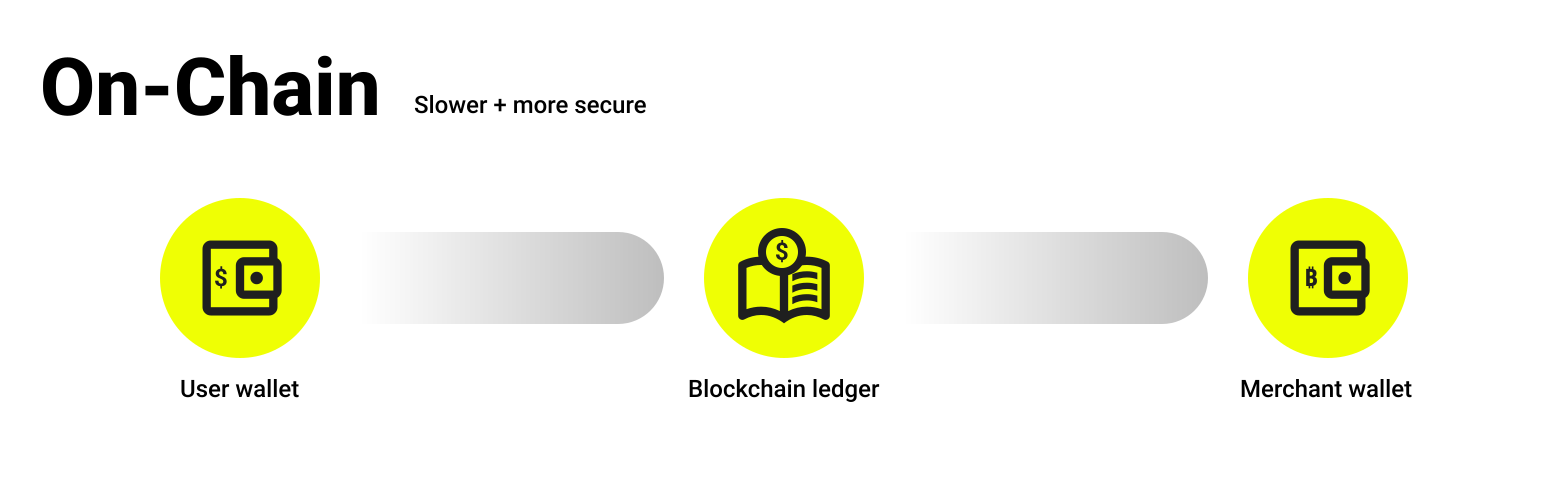
Onchain subscriptions rely on token-gating to verify access, which is fundamentally different from traditional payment processing. In a standard model, a platform collects a fee and manually manages user permissions. Onchain, the asset itself acts as the key. When a user holds a specific token or NFT in their wallet, the smart contract automatically validates ownership and grants access to gated content or community channels.
This shift moves the burden of access management from the creator to the protocol. Instead of maintaining separate login databases or subscription lists, creators deploy smart contracts that check the blockchain state in real time. If the wallet holds the required asset, access is granted; if not, it is denied. This automation reduces administrative overhead and eliminates the need for third-party intermediaries to verify recurring payments.
The result is a more transparent and immediate value exchange. Users know exactly what they are buying, and creators receive instant, verifiable proof of ownership. This mechanism ensures that only verified holders can interact with the content, creating a secure and efficient loop for monetization. The technology behind this verification is built on distributed ledgers, ensuring that no single actor can manipulate the history of onchain data, providing a single source of truth for all participants.
This approach also allows for more flexible monetization strategies. Creators can offer tiered access, where different tokens unlock different levels of content. They can also resell or transfer their access, creating a secondary market that can increase the value of the subscription over time. This flexibility is not possible with traditional subscription models, which are typically locked to a single user and payment method.
Market trends and institutional interest
The creator economy is no longer just about content; it is about financial infrastructure. In 2026, the shift toward onchain subscriptions is being driven by two converging forces: the maturation of onchain credit markets and the entry of institutional capital into creator finance.
Onchain credit is becoming a major trend in 2026 because it solves the liquidity problem that has long plagued subscription-based models. Creators can now borrow against their future recurring revenue, turning predictable income streams into immediate working capital. This mirrors traditional financial instruments but operates with the transparency and programmability of blockchain technology. As noted by the Bitcoin Foundation, these markets are gaining traction because they offer a more efficient way to allocate capital than traditional banking for digital-native businesses.
Institutional interest is following this utility. Events like ONCHAIN 2026, co-hosted by DigiFT, Saison Capital, and Libeara, are bringing together traditional finance leaders and tokenized innovation teams. This signals that institutional players are no longer just speculating on crypto assets but are building the rails for sustainable creator monetization.
To understand the market context, it helps to look at the underlying liquidity. The stability of these subscription models often relies on the broader crypto market's health.
This chart shows the recent price action and volume for Ethereum against USDC. Stablecoin dominance and ETH liquidity are key indicators for the health of onchain payment rails. When liquidity is deep and stable, subscription payouts are more reliable, and creators can trust that their revenue won't fluctuate wildly due to market volatility.
The combination of credit access and institutional backing creates a robust ecosystem. Creators are no longer dependent on centralized platforms that can change fees or ban accounts overnight. Instead, they operate in a transparent environment where their revenue is a verifiable asset, accessible to a global network of lenders and investors.
Data integrity and manipulation risks
Onchain subscriptions rely on the assumption that the data triggering payments is accurate and untampered. While blockchain consensus mechanisms prevent single actors from rewriting history, the inputs feeding those smart contracts remain vulnerable. This creates a trust gap between the immutability of the ledger and the veracity of the external data.
The primary risk lies in oracle manipulation. If a subscription service relies on a single data source to verify user activity or payment status, attackers can exploit price feeds or data oracles to trigger false events. For instance, a sudden, artificial spike in a token’s price could be used to unlock premium features without actual payment, draining protocol reserves.
To mitigate this, robust systems use decentralized oracle networks that aggregate data from multiple independent sources. This ensures that no single point of failure can compromise the integrity of the subscription logic. However, this complexity introduces new attack vectors, such as flash loan attacks that manipulate short-term market data to exploit poorly designed smart contract logic.
The solution requires a shift from trusting data providers to verifying data consensus. Protocols must implement multi-source validation and time-weighted averages to smooth out transient market anomalies. This approach ensures that subscription triggers are based on stable, consensus-driven data rather than easily manipulated short-term fluctuations.
Frequently asked questions about onchain subscriptions
Can onchain data be manipulated?
Onchain subscriptions rely on blockchain infrastructure where distributed nodes must agree on the validity of new data blocks before they are permanently appended to the ledger. This consensus mechanism ensures that no single actor can manipulate the history of onchain data, providing a single source of truth for all participants. Unlike centralized databases, there is no central administrator to bribe or hack to alter past records.
How do I cancel an onchain subscription?
Cancellation typically involves interacting directly with the smart contract that manages the subscription. Most protocols require you to send a transaction to revoke access or stop recurring payments. Unlike traditional services, there is often no customer support team to process a refund manually; you must execute the cancel function on-chain. Always check the specific contract terms to understand if funds are refundable or forfeited upon cancellation.
What happens if the blockchain network congests?
Network congestion can delay the processing of subscription payments or access updates. When the network is busy, transaction fees (gas) rise, and confirmation times lengthen. This may temporarily lock a creator out of their revenue stream or a subscriber out of content until the transaction is included in a block. Most modern onchain subscription platforms include fallback mechanisms or layer-2 solutions to mitigate these delays.
No comments yet. Be the first to share your thoughts!