
Choose a privacy-first identity provider
Selecting an onchain identity provider in 2026 requires balancing regulatory compliance with cryptographic privacy. The goal is to verify your identity without exposing raw personal data to the public ledger or third-party databases. Look for platforms that rely on zero-knowledge proofs (ZKPs) to validate attributes like age, residency, or accreditation. This approach allows you to prove you meet specific criteria without revealing your underlying personal information.
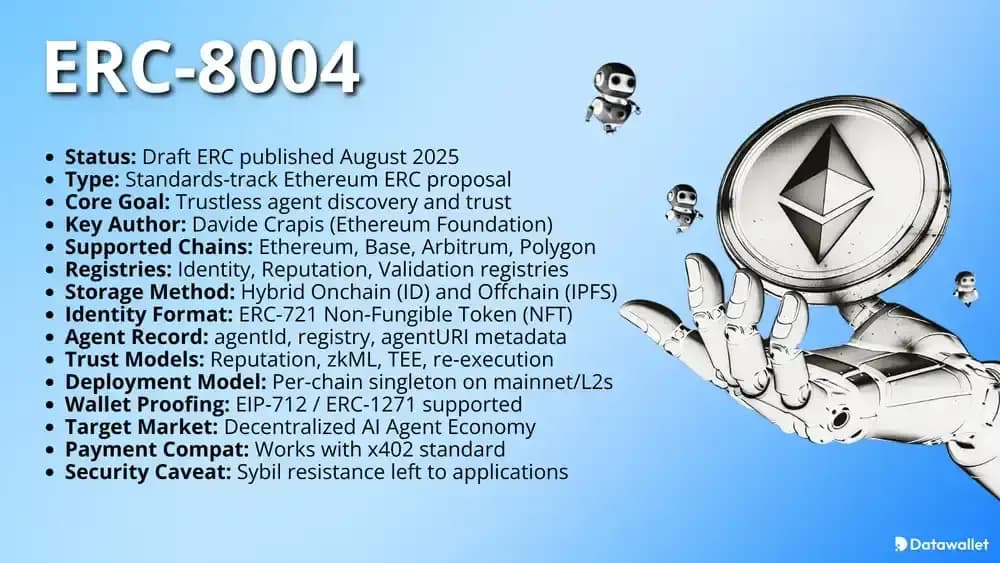
When evaluating providers, prioritize those that support emerging standards such as ERC-8004. This standard facilitates verifiable credentials for AI agents and human users alike, ensuring your identity remains portable across different decentralized applications. A provider that adheres to these standards will likely offer better interoperability and long-term viability as the regulatory landscape shifts.

Verify that the provider uses zero-knowledge proofs for all sensitive verifications. The system should allow you to prove a statement (e.g., "I am over 18") without revealing the proof itself (your birthdate). Avoid platforms that store raw KYC data on-chain or in accessible cloud databases.
Ensure the provider complies with 2026 regulatory frameworks in your jurisdiction. Look for partnerships with licensed KYC vendors or adherence to local financial regulations. This ensures your onchain identity is recognized by centralized exchanges and traditional financial institutions.
Confirm that the provider supports the blockchains you use most. A robust identity protocol should issue credentials that are readable across multiple networks, preventing you from being locked into a single ecosystem. Check for support of standard credential formats like W3C Verifiable Credentials.
The following table compares leading identity providers based on their privacy architecture, compliance level, and supported chains. Use this to filter options that meet your specific technical and legal requirements.
| Provider | Privacy Model | Compliance Level | Supported Chains |
|---|---|---|---|
| Worldcoin | Biometric ZK-Proofs | High (Global KYC) | Ethereum, Base, Optimism |
| Civic | Self-Sovereign ZK | Medium (EU/US) | Ethereum, Polygon, Solana |
| Spruce ID | Decentralized Credentials | Low (Developer Tool) | Multi-Chain (SDK) |
| Portal ID | ZK-Attestations | High (Enterprise) | Ethereum, Arbitrum |
Connect your wallet and select verification level
Onchain identity works by linking a decentralized wallet to a real-world identity credential. This process requires you to connect your wallet to an identity provider and choose a verification tier. The tier you select determines how much personal data you share and what onchain assets you can access.
Choose your verification tier
Before connecting your wallet, decide whether you need basic or full KYC (Know Your Customer) verification. Basic verification typically uses a zero-knowledge proof to confirm you are a unique human without revealing your name. This is sufficient for most general onchain interactions. Full KYC requires submitting government ID and proof of address. This tier is mandatory for accessing regulated assets, such as tokenized money market funds or institutional-grade financial products [src-serp-8].
Connect your wallet to the provider
- Navigate to the identity provider’s official dashboard. Ensure you are on the legitimate domain to avoid phishing sites.
- Click the "Connect Wallet" button. Your wallet extension (like MetaMask or Rabby) will prompt you to sign a message. This signature proves you control the address without spending any funds.
- Select your preferred verification level. The provider will display the data requirements for that tier. For full KYC, you will be redirected to a secure document upload portal.
Once the wallet is linked and the tier is selected, the provider will initiate the verification workflow. Automated checks usually complete within minutes, while manual reviews for full KYC may take up to five business days [src-serp-8]. Keep your wallet active during this process to ensure the onchain attestation is correctly recorded.
Submit documents using zero-knowledge proofs
Zero-knowledge proofs (ZKPs) allow you to prove you meet a requirement without revealing the underlying data. Instead of uploading a raw photo of your passport to a public server, you generate a cryptographic signature that confirms your age is over 18, your name matches a government record, or your address is in a specific region. The blockchain only sees the proof, not the document itself.
This process shifts your onchain identity from a public ledger of personal details to a set of verifiable credentials. You retain control of the data, sharing only the minimum necessary to pass a compliance check. This approach is essential for privacy-preserving identity systems that link real-world attributes to a blockchain address without exposing them to the public.
1. Choose a compatible identity provider
Select a decentralized identity provider that supports the specific zero-knowledge proof standards required by the platform you are using. Providers like Worldcoin or Polygon ID handle the complex cryptographic setup, allowing you to create a reusable identity credential. Ensure the provider is compatible with the blockchain network you are interacting with.
2. Verify your identity with the provider
Complete the verification process with your chosen provider. This typically involves uploading a government-issued ID and a selfie for liveness detection. The provider verifies the document against official databases and issues a signed credential to your wallet. This step happens off-chain or on a private layer, keeping your personal data separate from the public blockchain.
3. Generate the zero-knowledge proof
When a dApp requires verification, use your wallet to generate a ZKP from your stored credential. The proof mathematically demonstrates that you satisfy the condition (e.g., "is over 18") without revealing your birthdate or name. This proof is a unique cryptographic string that changes with every request, preventing replay attacks.
4. Submit the proof to the target contract
Send the generated proof to the smart contract or service that requested verification. The contract validates the cryptographic signature against the provider’s public key. If the proof is valid, the contract grants you access or updates your onchain reputation score. You can now interact with the platform without having ever revealed your actual identity documents.
Review your onchain reputation score
Once the verification steps are complete, the system generates a persistent identity status. This status usually takes the form of a Soulbound Token (SBT) or a reputation score stored on-chain. Unlike a standard NFT, an SBT cannot be transferred or sold, meaning it stays permanently attached to your wallet address as proof of your verified history.
Check for Soulbound Tokens (SBTs)
Navigate to your wallet’s NFT tab or a dedicated identity explorer like zkSync or Base. Look for non-transferable tokens issued by the verification protocol you used. These tokens act as digital badges. Their presence signals to other protocols that you are a real, verified human rather than a bot account. If the token is missing, the verification process may not have finalized on the blockchain.
Interpret your reputation score
Some platforms calculate a numeric reputation score based on your activity history and verification depth. A higher score typically indicates greater trustworthiness. For example, a score derived from multiple identity proofs is more valuable than one based on a single email address. Check the specific protocol’s documentation to understand the scoring criteria. Daon’s 2026 predictions note that continuous assurance is becoming the standard, meaning your score may update dynamically as you interact with more trusted services.
Verify compatibility with target protocols
Before relying on your new identity, ensure the receiving platform recognizes the specific SBT or score you hold. Not all protocols accept the same verification standards. If you plan to use your identity across multiple DeFi or social platforms, check if they support the same identity provider. Mismatched standards can lead to rejected applications or limited access to features.
Use your verified identity for DeFi access
Once you have completed identity verification through a trusted provider, the next step is applying that credential to access regulated financial products. The most common entry point is tokenized money market funds, which offer onchain yield while maintaining regulatory compliance. These instruments require "clearing access," meaning the fund issuer must verify your identity and add your wallet address to the fund's onchain whitelist.
To gain this access, you must link your verified identity to the specific protocol you wish to use. This process ensures that your financial activities remain within legal boundaries while allowing you to hold and trade tokenized assets. The verification acts as a key, unlocking access to a broader range of compliant DeFi opportunities that were previously restricted to traditional banking customers.
The process generally involves connecting your wallet to the fund's interface, selecting your verified identity provider, and confirming the transaction. Once the whitelist inclusion is confirmed on-chain, you can interact with the fund's smart contracts. This seamless integration allows you to maintain privacy while proving your eligibility to participate in regulated markets.
Navigate to the official interface of the tokenized fund or regulated DeFi protocol. Connect your Web3 wallet to the platform. Ensure you are on the correct network and that your wallet is ready to sign transactions for identity verification.
Choose the identity provider through which you completed your verification. This could be a known service like Eco or another compliant provider. The protocol will redirect you to the provider's interface to authorize the sharing of your verification status.

Review the permissions requested by the protocol. You are authorizing the fund to confirm your identity status and add your wallet to the whitelist. Confirm the transaction in your wallet. This step is critical for clearing access to the fund's assets.
Wait for the transaction to be confirmed on the blockchain. Once confirmed, your wallet address will appear on the fund's whitelist. You can now interact with the tokenized money market fund, such as purchasing shares or redeeming them, without further identity checks.
Checklist for accessing regulated DeFi protocols with verified identity:
-
Identity verification completed with a trusted provider
-
Wallet connected to the regulated protocol
-
Whitelist inclusion confirmed on-chain
-
Ready to interact with tokenized assets
Frequently asked questions about onchain identity
How long does onchain identity verification take?
Verification speed depends on your submission quality. If your documents are clear and consistent, automated checks typically finish in 5 minutes to 2 hours. Errors trigger manual review, extending the process to approximately 5 business days. Blockchain.com notes that consistent data entry is the fastest path to approval.
What is onchain identity?
Onchain identity links real-world attributes or digital reputation to a blockchain address using cryptographic proofs. Systems like ONCHAINID allow individuals and organizations to enforce compliance and access digital assets without exposing sensitive personal data on public ledgers. Chainlink explains this as a privacy-preserving method to prove identity on-chain.
Is blockchain relevant in 2026?
Blockchain remains relevant in 2026, but its role has narrowed to practical use cases. It is no longer a "magical database" but a coordination tool for systems that do not trust each other. Experts suggest treating it as infrastructure for verifying identity and assets rather than a general-purpose solution for all data problems.
No comments yet. Be the first to share your thoughts!