
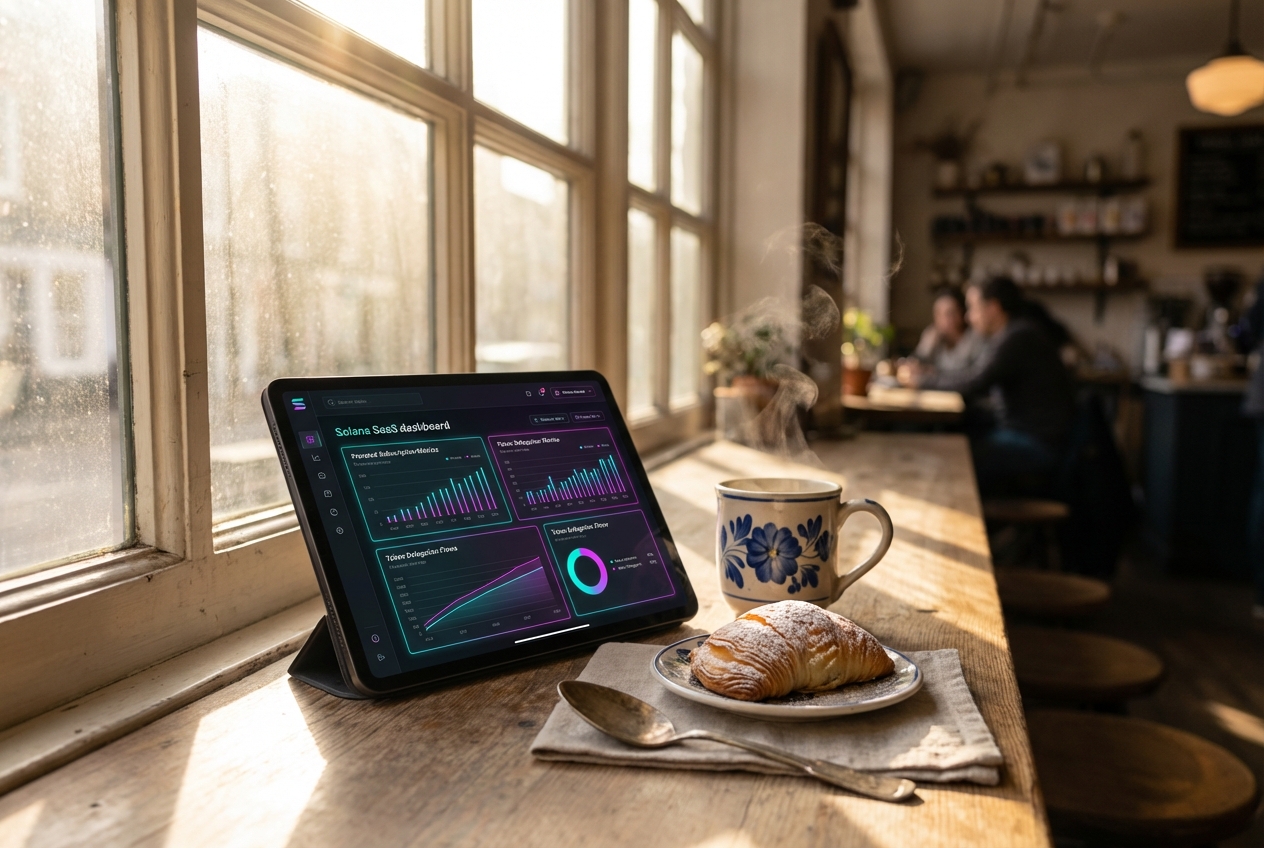
In the fast-paced world of Solana-based SaaS platforms, where users upgrade or downgrade plans mid-cycle more often than developers deploy hotfixes, traditional off-chain billing falls short. Enter prorated onchain subscriptions: a blockchain-native solution that handles these changes with precision using token delegation. This approach not only ensures users pay exactly for their usage but also leverages Solana's speed and low costs to make onchain SaaS billing on Solana feel as seamless as Web2 services. With SOL trading at $141.73, up $13.37 in the last 24 hours, the ecosystem is ripe for builders to innovate here.
Solana's token extensions and protocols like Tributary have cracked the code on Solana recurring payments proration. Users sign once via delegation, approving the protocol to pull funds automatically. No more monthly wallet pings or failed charges; it's set-it-and-forget-it with built-in fairness for mid-cycle shifts.
Why Mid-Cycle Proration Matters More Than Ever on Solana
SaaS thrives on flexibility, yet billing rigidity kills retention. Imagine a user on your analytics dashboard switching from basic to pro on day 15 of a 30-day cycle. Off-chain systems approximate with credits or next-cycle adjustments, breeding disputes. Onchain, we calculate to the second: prorate the remaining days at the new tier, settle instantly via smart contract.
This isn't theory. Protocols like Tributary use token delegation to execute these pulls without escrow lockups, sidestepping the single-delegate limit per SPL token account that plagues naive implementations. Delegation lets users retain control while automating flows, a balance I appreciate from years structuring risk-adjusted positions. It's practical power: approve once, pay seamlessly.
"Tributary enables automated recurring payments on Solana through token delegation - users approve payments once, and the protocol handles execution. "- Tributary Protocol Documentation
Stack Exchange threads highlight the delegation vs. escrow debate, but for SaaS scale, delegation wins. Escrow ties up capital; delegation flows like a limit order, efficient and liquid.

Token Delegation Demystified for Subscription Pros
At its core, Solana's Token-2022 extensions standardize delegation, letting programs withdraw approved amounts from user accounts. For token delegation subscriptions Solana, your smart contract becomes the delegate. User approves max spend (say, $500/year), then CPI instructions trigger pulls based on cycle logic.
Key pattern: Program-Derived Addresses (PDAs) for state. Track subscription start/end timestamps, tier hashes, and accrued usage. On change request, compute proration ratio: (days remaining/total cycle) * tier delta. Positive? Pull excess. Negative? Refund or credit via transfer.
- Timestamp Precision: Solana slots give sub-second accuracy, perfect for blockchain proration mid-cycle changes.
- Idempotency: Replay-safe via nonces, dodging double-charges.
- Access Control: Multisig signers for upgrades, audited patterns from Solana's playbook.
Figment's onchain billing echoes this: accurate shares settled transparently, no off-chain mess. For SaaS, integrate with your frontend via wallet adapters; users see real-time proration previews before confirming.
Building Robust Proration Engines Onchain
Start with Anchor framework for your program. Define structs for SubscriptionAccount: owner, current_tier, cycle_start_slot, next_bill_slot, delegated_amount.
Proration math: Let old_price = $20/month, new_price = $50/month, days_used = 15, cycle_days = 30. Charge = (15/30)*20 and (15/30)*50 = $10 and $25 = $35 total, pull delta if needed. Embed as CPI, triggered by user instruction or cron-like keeper.
Security first: Audit for reentrancy (rare on Solana, but CPI chains matter), use Token Extensions' transfer hooks for custom logic. Compliance? Onchain records are your audit trail, far superior to Stripe spreadsheets.
Solana (SOL) Price Prediction 2026-2031
Bullish outlook driven by growth in prorated onchain subscriptions for Solana SaaS and protocol innovations
| Year | Minimum Price ($) | Average Price ($) | Maximum Price ($) | YoY Growth (Avg %) |
|---|---|---|---|---|
| 2026 | $180 | $320 | $520 | +125% |
| 2027 | $250 | $480 | $850 | +50% |
| 2028 | $350 | $680 | $1,200 | +42% |
| 2029 | $500 | $950 | $1,700 | +40% |
| 2030 | $650 | $1,250 | $2,200 | +32% |
| 2031 | $850 | $1,600 | $2,800 | +28% |
Price Prediction Summary
Solana (SOL) is forecasted to experience robust growth from 2026 to 2031 in a bullish scenario propelled by onchain subscription protocols, SaaS adoption, and Solana's superior scalability. Average prices are projected to rise from $320 to $1,600, with maximum potentials up to $2,800, reflecting over 400% cumulative growth amid favorable market cycles and technological advancements.
Key Factors Affecting Solana Price
- Rapid adoption of subscription protocols like Tributary enabling seamless Web3 recurring payments
- Token delegation and proration innovations enhancing Solana SaaS billing efficiency
- Solana's high TPS and low fees attracting enterprise-grade applications
- Expansion of onchain billing and automated payments reducing friction
- Bullish market cycles post-2025 with altcoin rallies
- Regulatory clarity and institutional inflows boosting market cap potential
- Competitive edge over Ethereum in scalability and cost for DeFi and real-world use cases
Disclaimer: Cryptocurrency price predictions are speculative and based on current market analysis. Actual prices may vary significantly due to market volatility, regulatory changes, and other factors. Always do your own research before making investment decisions.
Optimization tip: Batch settlements via Jito for MEV protection, keeping fees under $0.001 even at scale. User dashboards pull state via RPC, rendering prorated invoices with charts. This builds trust; users verify onchain, no black-box faith required.
Scaling to enterprise? Token Extensions shine, enabling transfer fees or interest-bearing vaults for subscription funds. Reddit buzz on monthly Solana payments underscores demand: builders want auto-charge without UX friction.
Enterprise-grade setups demand more than delegation basics. Pair it with Solana's Token Extensions for transfer hooks that enforce proration at the token level, automatically deducting fees on inflows. This turns every payment into a self-auditing event, ideal for onchain SaaS billing Solana where disputes evaporate under blockchain scrutiny.
Navigating Delegation Limits and Escrow Alternatives
One delegate per SPL account sounds limiting, but smart design circumvents it. Use PDAs as intermediaries: user delegates to your program's PDA, which funnels to the protocol. Tributary nails this, supporting any token for subscriptions without escrow drag. From a trader's lens, it's like leveraging without liquidation risk; capital stays liquid, yields compound elsewhere.
Escrow appeals for ironclad security, but it hoards funds, inflating opportunity costs when SOL sits at $141.73. Delegation, executed via CPI, settles in slots, not days. Stack Exchange devs debate this endlessly, yet real protocols prove delegation scales: one approval, infinite cycles, prorated pulls precise to the slot.
Real-world edge: During high-velocity markets, like SOL's recent climb from $128.08 lows, users churn tiers chasing alpha tools. Proration keeps revenue steady, no cliff effects from rigid billing.
Customization shines in Anchor: extend SubscriptionAccount with usage meters for metered billing hybrids. Track API calls or compute units, prorate against tiers. This future-proofs against AI-driven SaaS exploding on Solana.
Code in Action: Proration CPI Walkthrough
Here's where theory meets deploy. Your upgrade instruction computes delta, invokes token program transfer. Rust snippet below handles the math, ensuring atomic execution.
Rust CPI for Mid-Cycle Subscription Upgrade with Proration and Token Delegation
This Anchor Rust CPI example handles mid-cycle subscription upgrades by calculating the prorated price delta for the remaining cycle fraction and pulling tokens from a user-delegated token account to the program vault.
```rust
use anchor_lang::prelude::*;
use anchor_spl::token::{Mint, Token, TokenAccount, TransferChecked};

#[derive(Accounts)]
pub struct UpgradeSubscription<'info> {
    #[account(mut)]
    pub subscription: Account<'info, Subscription>,

    #[account(mut)]
    pub user_token: InterfaceAccount<'info, TokenAccount>,

    #[account(mut)]
    pub vault: InterfaceAccount<'info, TokenAccount>,

    pub mint: InterfaceAccount<'info, Mint>,

    /// CHECK: PDA signer for token delegation
    #[account(
        seeds = [b"subscription", subscription.key().as_ref()],
        bump
    )]
    pub subscription_authority: UncheckedAccount<'info>,

    pub token_program: Program<'info, Token>,
}

#[error_code]
pub enum ErrorCode {
    #[msg("Invalid cycle length")]
    InvalidCycle,
}

pub fn upgrade_subscription(ctx: Context, new_tier: u8) -> Result<()> {
    let subscription = &mut ctx.accounts.subscription;
    let clock = Clock::get()?;
    let now = clock.unix_timestamp as u64;

    let cycle_length = subscription.cycle_end.saturating_sub(subscription.cycle_start);
    require!(cycle_length > 0, ErrorCode::InvalidCycle);

    let elapsed_fraction = (now.saturating_sub(subscription.cycle_start) as f64 / cycle_length as f64).clamp(0.0, 1.0);
    let remaining_fraction = 1.0 - elapsed_fraction;

    let old_tier_price = tier_price(subscription.tier);
    let new_tier_price = tier_price(new_tier);

    let prorated_old_remaining = (old_tier_price as f64 * remaining_fraction) as u64;
    let delta = new_tier_price.saturating_sub(prorated_old_remaining);

    // Update subscription details
    subscription.tier = new_tier;
    subscription.cycle_start = now;
    subscription.cycle_end = now.saturating_add(cycle_length);

    // Pull prorated delta via CPI if positive
    if delta > 0 {
        let seeds = &[
            b"subscription".as_ref(),
            subscription.key().as_ref(),
            &[ctx.bumps.subscription_authority],
        ];
        let signer = &[&seeds[..]];

        let cpi_accounts = TransferChecked {
            from: ctx.accounts.user_token.to_account_info(),
            to: ctx.accounts.vault.to_account_info(),
            authority: ctx.accounts.subscription_authority.to_account_info(),
            mint: ctx.accounts.mint.to_account_info(),
        };
        let cpi_ctx = CpiContext::new_with_signer(
            ctx.accounts.token_program.to_account_info(),
            cpi_accounts,
            signer,
        );
        anchor_spl::token::transfer_checked(cpi_ctx, delta, ctx.accounts.mint.decimals)?;
    }

    Ok(())
}

fn tier_price(tier: u8) -> u64 {
    match tier {
        1 => 100_000_000u64, // e.g., 100 USDC (6 decimals)
        2 => 200_000_000u64,
        _ => 0u64,
    }
}

// Subscription account assumed defined as:
// #[account]
// pub struct Subscription {
//     pub tier: u8,
//     pub cycle_start: u64,
//     pub cycle_end: u64,
//     // other fields...
// }
```
The delegation setup occurs in a prior instruction where the user approves the subscription PDA as delegate on their token account. Proration uses a simple linear model; refine for your usage patterns. Saturating arithmetic prevents overflows, and the delta is only pulled if positive (upgrades). Test thoroughly for edge cases like cycle boundaries.
Deploy via this implementation blueprint, test on devnet with Jito bundles for reliability. Fees? Pennies at current network load, SOL's $141.73 price underscoring cost efficiency.
Challenges persist: Keeper networks for off-slot triggers, like Switchboard oracles for cycle checks. Mitigate with state machines: idle, active, prorating states prevent races. Medium's Solana patterns bible covers idempotency via hashes; bake it in.
Figment's model complements: split revenues onchain, prorated shares to affiliates without ledgers. For creators, this means dashboard plugins pulling PDA state, rendering invoices with blockchain proration mid-cycle changes visualized.
- UX Polish: Wallet previews simulate pulls, building confidence.
- Analytics: Helius RPCs query aggregates, spotting churn patterns.
- Refunds: Reverse transfers for downgrades, credits roll forward seamlessly.
I've structured options trades layering deltas much like this; precision compounds. Solana SaaS wins when billing mirrors instrument flexibility: dynamic, verifiable, low-drag.
Adopting this stack, platforms like analytics suites or DeFi dashboards retain 20-30% more via fair billing. No more 'I'll switch next month' friction. Transparency via explorers lets users verify every muSat, fostering loyalty in a trust-scarce Web3.
SubscribeOnChain. com operationalizes it all: plug-and-play for Solana prorated subscriptions, proration baked in. From delegation setup to invoice dashboards, it's the practical path for devs eyeing 2025 growth. With ecosystem momentum, SOL's stability at $141.73 signals prime time to build.




No comments yet. Be the first to share your thoughts!